Prototype & Validation: What We Have Built — and Where the Boundaries Are
Benran Zhiqu has built a physical AI voice-interaction prototype for children’s toy scenarios and completed a basic voice-input-to-response loop together with a method for authoring scene-aware dialogue. This page records R&D-stage facts; it does not claim mass production, customer deployment, or validated child-development outcomes.
Published
Last verified
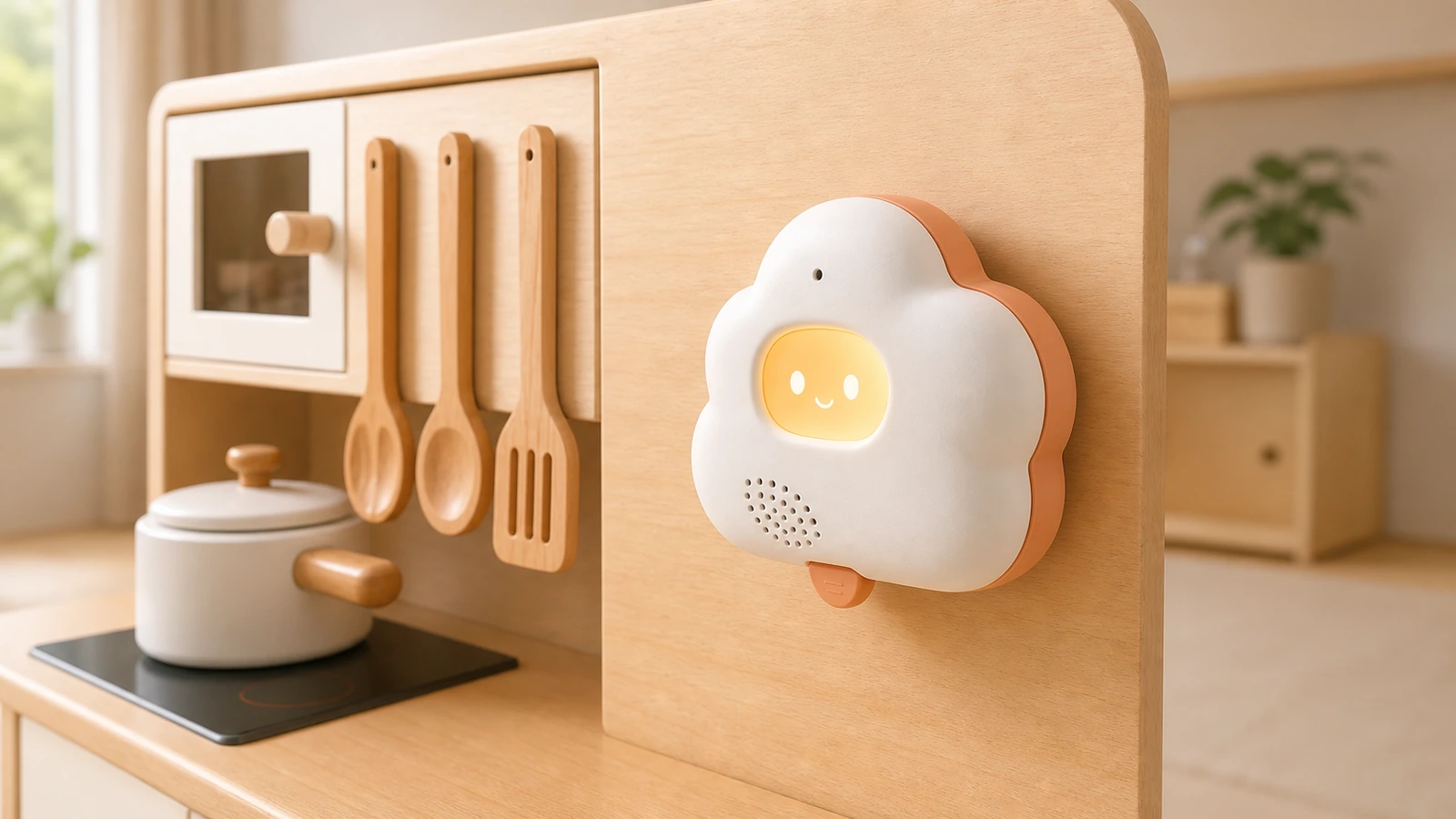
Concept rendering of an AI voice-interaction module, shown only to explain the design and mounting approach. It does not represent the final production appearance.
PUBLISHED CONCEPT VIDEOS / D-E-C
Three public views of the same R&D direction
These are AI-generated concept visualizations, not footage of the physical prototype or the final manufactured product.
D-v2 / 16 seconds / published July 15, 2026
AI Voice Module for Toys: Three Play Worlds | Bontoys #Shorts
Visual description
A cloud-shaped concept module appears on a wooden toy kitchen, market stall, and toy workbench before a final standalone product view.
Audio description
No spoken narration is claimed. The published clean master uses the generator's original audio and no post-produced voiceover.
AI Voice Module for Toys: Cloud-Shaped Product Study | Bontoys #Shorts
Visual description
Close front, side, and rear concept views show the face display, speaker openings, orange shell, and circular mounting surface before the module appears on a toy kitchen.
Audio description
No spoken narration is claimed. The published clean master uses the generator's original audio and no post-produced voiceover.
A physical hardware prototype has been built for R&D validation.
F-02Basic voice loop
The basic voice-input, processing, and response loop is working.
F-03Scene-aware dialogue
A method exists for authoring dialogue around toy types and play scenarios.
F-04Retrofit assessment
The prototype can support an initial assessment of whether an existing toy is suitable for a voice-interaction module.
INTERACTION METHOD / FLOW
How the prototype organizes a response
01
A child starts speaking
02
The system identifies the toy and play context
03
It selects an appropriate response
04
The interaction continues or ends without taking over the child’s play
EVIDENCE BOUNDARY / LIMITS
Claims this page does not make
L-01
This page does not claim mass production or direct availability for purchase.
L-02
This page does not claim customer deployment, commercial adoption, or market scale.
L-03
This page does not claim language, cognitive, social, or learning outcomes for children.
L-04
Partners, confidential projects, and unauthorized test records are not disclosed here.
L-05
This is toy-interaction R&D, not a child-facing learning app.
PARTNER ASSESSMENT / NEXT
Assess suitability before integration
Toy brands and manufacturers may share a product form factor, its primary play pattern, and the intended interaction scenario. Benran Zhiqu will first assess whether the toy is suitable for a voice-interaction module before any further validation work is proposed.
 Bontoys by Benran